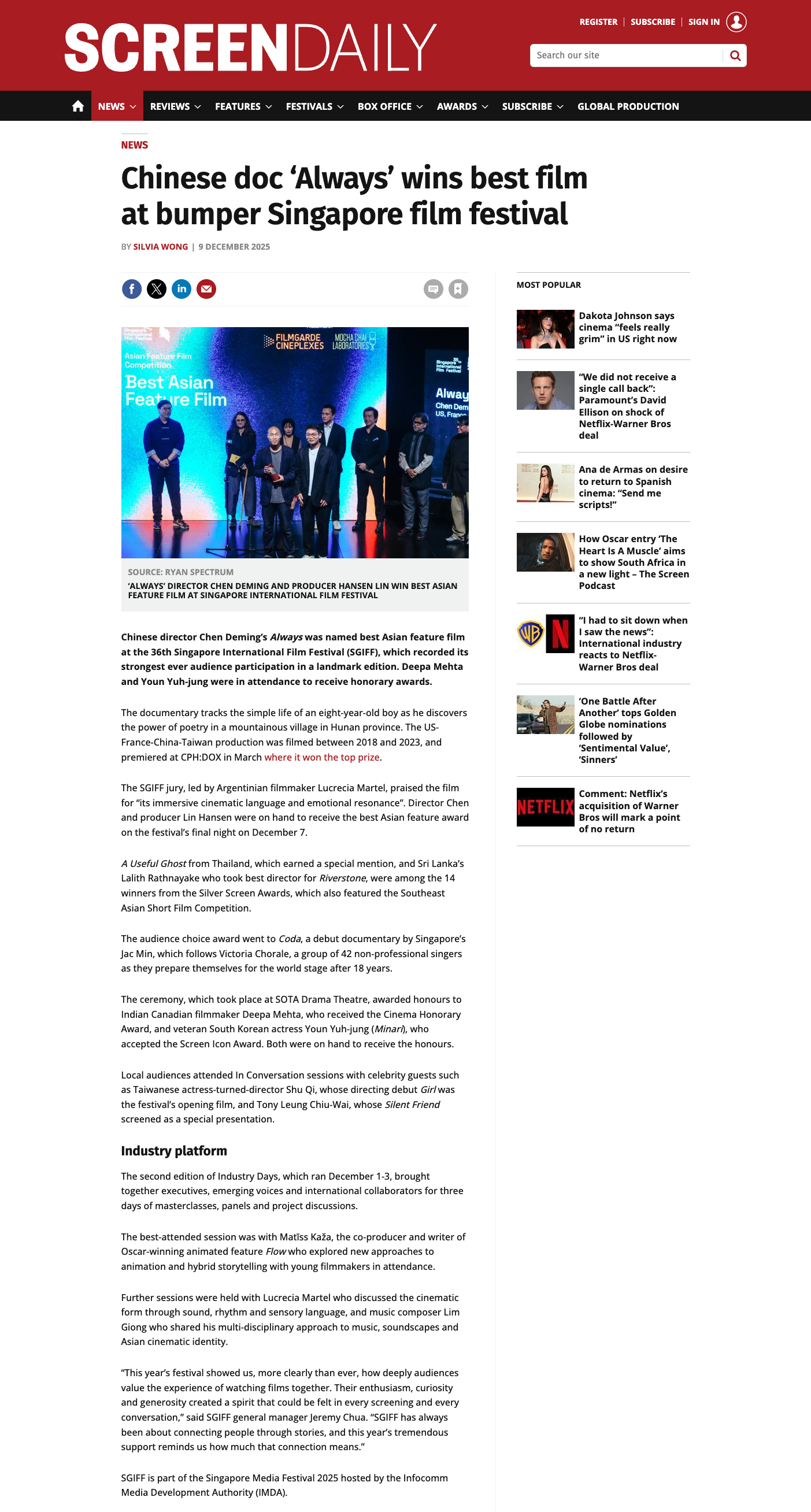
コーダ Coda recently played at the 2026 Cannes International Film Week, where Final Cut Magazine featured the film in a profoundly resonant review.
Read more —
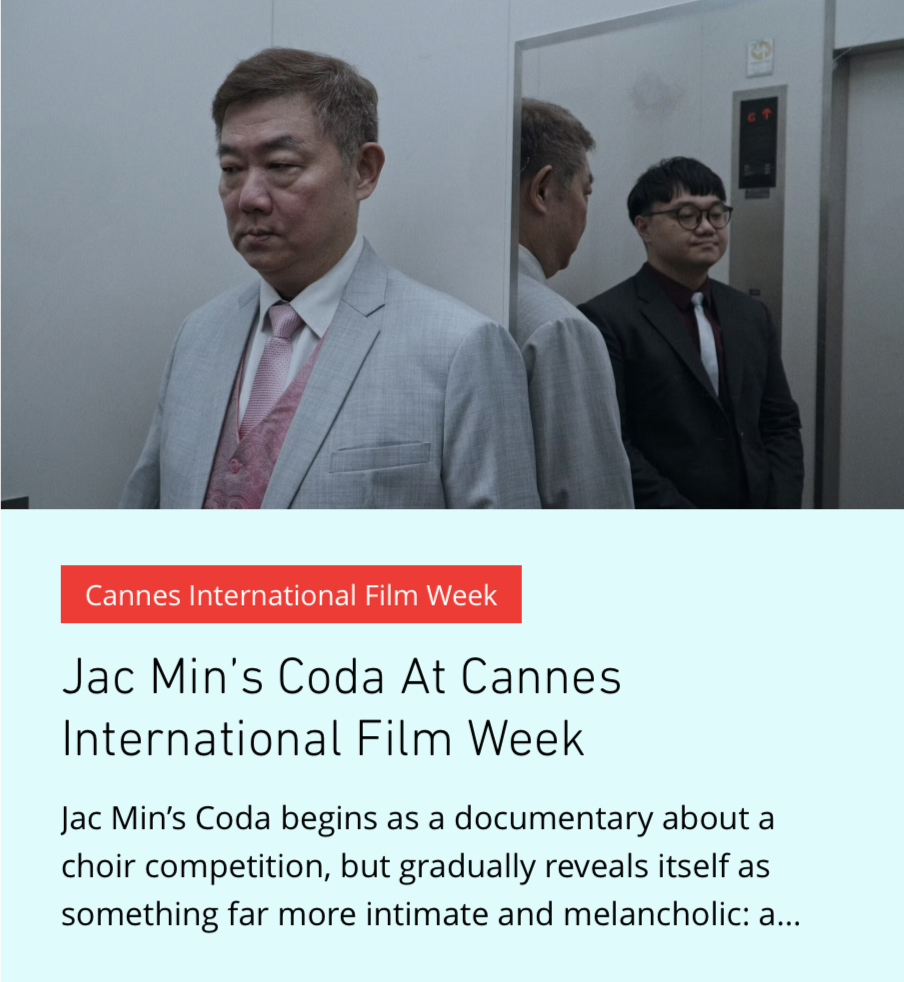
Jac Min’s Coda begins as a documentary about a choir competition, but gradually reveals itself as something far more intimate and melancholic: a meditation on ambition, memory, aging, artistic sacrifice, and the fragile role of art within a relentlessly pragmatic society. Selected for the Cannes International Film Week, the film follows Singapore’s Victoria Chorale as they prepare to return to the international competition stage in Tokyo after an absence of eighteen years — a comeback shadowed by the possibility that it may also be their final performance together.
At first glance, the premise appears deceptively narrow. A choir rehearses. Members discuss logistics. The conductor pushes for perfection. Plane tickets are booked. Harmonies are refined. Yet Coda slowly accumulates emotional weight through observation rather than exposition. Jac Min refuses the conventional documentary structure of explanatory talking heads and neatly packaged emotional arcs. Instead, he allows the viewer to inhabit the rhythms of rehearsals, exhaustion, silence, anxiety, and fleeting camaraderie. The result is a film that feels less like a documentary “about” a choir and more like being absorbed into one.
This approach has divided audiences. Some viewers found themselves frustrated by the film’s deliberate distance — the sparse interviews, the lack of biographical signposting, the refusal to over-explain motivations or interpersonal tensions. Others were profoundly moved precisely because of that restraint. In many ways, Coda mirrors the discipline of choral singing itself: individual identities dissolve into a collective emotional experience. We may not remember every singer’s name, but by the end, we feel their shared longing, pressure, and vulnerability.
The film’s most fascinating tension lies in its exploration of competition within art. The Victoria Chorale members are not teenagers chasing medals for school prestige; they are adults returning to an almost forgotten dream. Careers, marriages, responsibilities, and age now complicate what once may have seemed pure. The Tokyo competition becomes less about victory than about reclaiming a version of themselves that existed before adulthood reduced art to a hobby or memory.
Jac Min, himself a former member of the choir, understands this tension intimately. His camera captures not only rehearsals but also the emotional contradictions beneath them: the awkward discussions over perfectionism, the suppressed frustrations, the exhaustion of balancing artistic devotion with ordinary life. One particularly striking aspect of the documentary is how “Singaporean” it feels — not merely geographically, but culturally. Emotion is often indirect, compressed beneath discipline and functionality. Tears appear before explanations do. Feelings emerge through gesture, silence, and music rather than confession. This restraint gives Coda an unusual authenticity.
The film becomes especially powerful once the choir reaches Tokyo. Here, the documentary transforms into something suspenseful and unexpectedly cinematic. The competition sequences are not treated as triumphant sports-movie climaxes but as moments of almost unbearable vulnerability. Jac Min understands the terror of performance: the awareness that years of preparation can dissolve within minutes under the scrutiny of judges and audiences. The singers’ faces before stepping onstage carry the same emotional nakedness one might find in a war film.
What elevates Coda further is its sound design and musical immersion. Hearing the choir’s soaring harmonies in a cinema setting creates moments of genuine transcendence. Several audience members described getting goosebumps during the performances, and rightly so. The film understands that music does not need translation. In its strongest moments, the documentary abandons explanation altogether and simply allows voices, breath, and rhythm to communicate what words cannot.
Visually, Jac Min occasionally moves beyond observational realism into lyrical montage. One sequence — pairing choral music with images of water, deer, and landscapes — introduces a near-spiritual dimension to the film. These passages suggest memory itself drifting through the music, as though the singers are attempting to preserve fleeting fragments of youth before they disappear entirely.
The emotional crescendo arrives not necessarily in the competition results, but in the realization that what matters is the act of gathering itself. The title Coda — a musical ending, but also an afterlife of a melody — becomes deeply resonant. These singers are confronting endings everywhere: the end of youthful ambition, perhaps the end of the ensemble, perhaps even the end of a certain Singaporean artistic ideal that once prized international excellence with unapologetic intensity.
What makes the film linger is its refusal to simplify success or failure. It asks uncomfortable questions: Why do artists compete? Can art survive measurement? Does recognition validate sacrifice? And in a society obsessed with practical achievement, what place remains for collective artistic devotion?
The documentary’s imperfections are real. At over two hours, it occasionally drifts. Some viewers may indeed crave deeper contextualization or stronger narrative scaffolding. But there is also courage in Jac Min’s refusal to force emotional clarity. He trusts the audience to sit within ambiguity, much like the singers themselves.
By the end of Coda, something remarkable happens: the audience begins to feel like members of the choir. We share in the nervous anticipation backstage, the relief after performances, the exhausted dinners, the tiny emotional fractures that emerge under pressure. The film quietly transforms spectatorship into participation.
In an era dominated by fast content and simplified emotional storytelling, Coda dares to move at the pace of lived experience. It is not merely a documentary about singing. It is about what remains of us when ambition fades, when youth passes, and when the only thing left is the memory of voices once raised together in pursuit of something larger than ourselves.